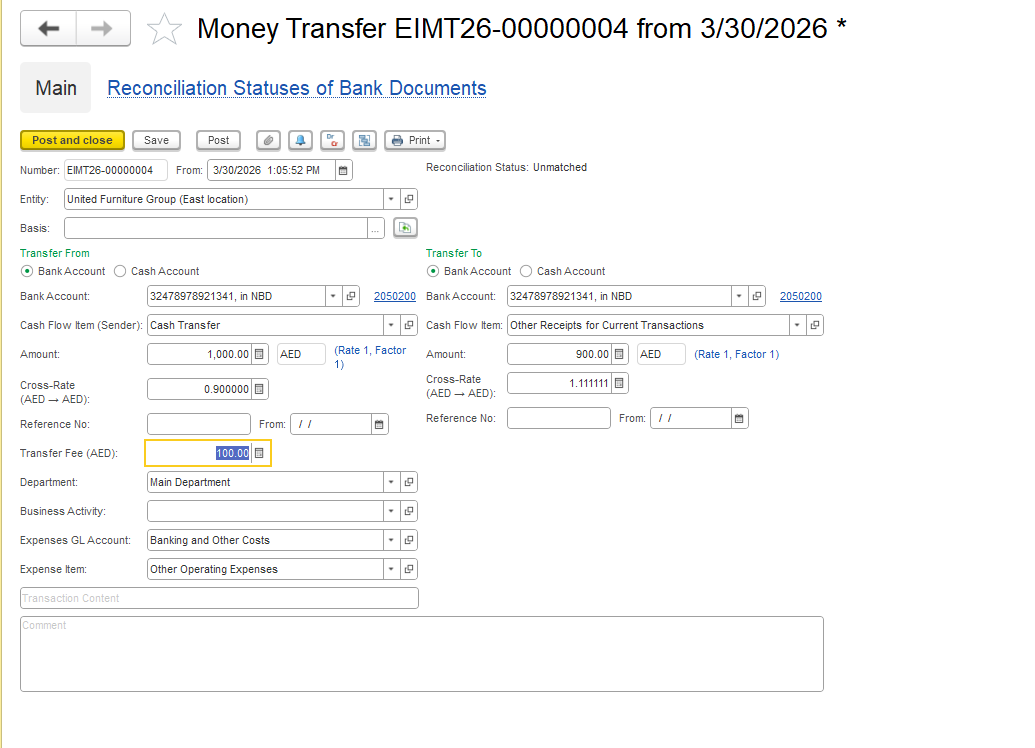
In FirstBit ERP, the Transfer Fee is the bank or payment system commission for processing a field in the Money Transfer.
It is recorded separately from the transfer amount and shown as an expense in accounting.
The Transfer Fee can either:
- be charged in addition to the transfer amount, or
- be included within the total amount
It also affects the final amount deducted from the sender or received by the recipient, depending on the selected method.
Transfer Fee Field in Foreign Currency Transfers
The Transfer Fee tab is used to record any additional expenses related to a transfer, including those arising from foreign currency transactions.
When transferring funds between accounts in different currencies, the system automatically provides the Transfer Fee field, allowing you to enter any conversion costs or bank charges associated with the transaction.
The system applies the official exchange rate for the transaction. However, if the transfer is processed using the bank’s commercial rate, which differs from the official rate, the resulting difference is treated as a bank expense (bank margin) and should be recorded in the Transfer Fee field.
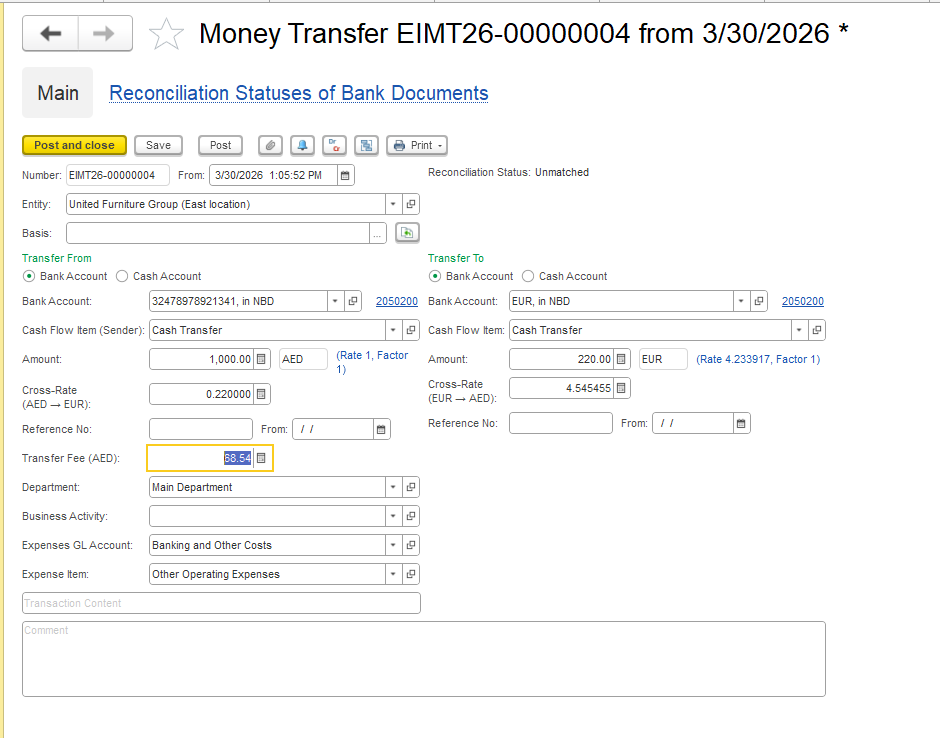
Transfer Fee = (New Amount in Source Currency × Current Cross Rate) − (Amount in Target Currency)
Where:
- New Amount in Source Currency – the new transfer amount in the source currency
- Current Cross Rate – the recalculated cross-currency rate after the amount change
- Amount in Target Currency – the amount previously calculated or specified in the document
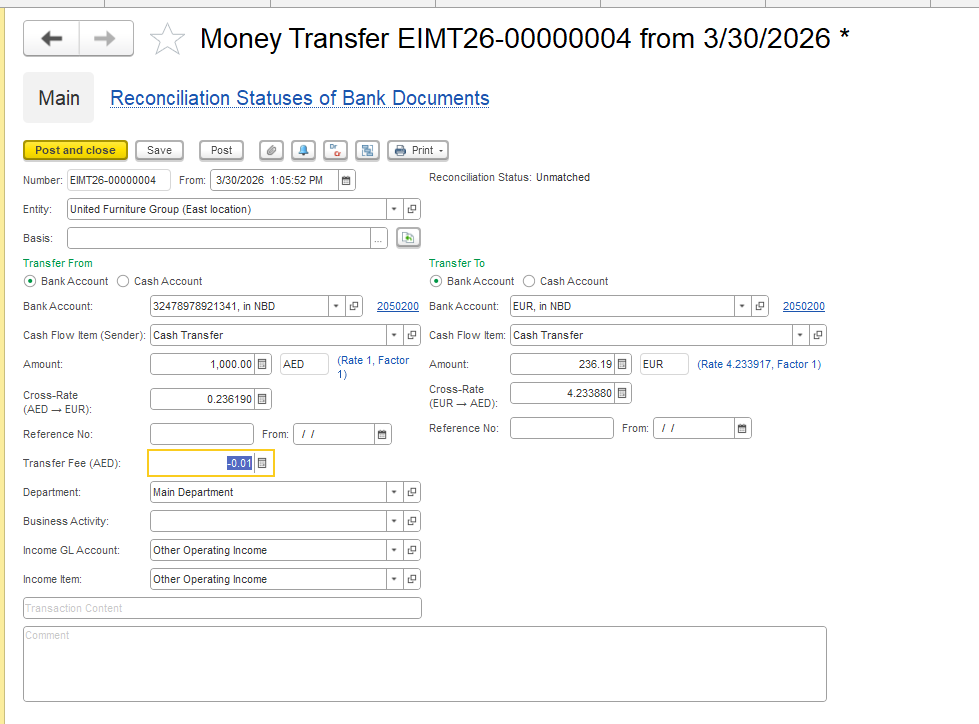
1000 * 0,22 - (1000* 0,236 (initially set course) = 16,19 * 4,23388 = 68,54
1). Before change Transfer Amount
2). After changing Transfer Amount
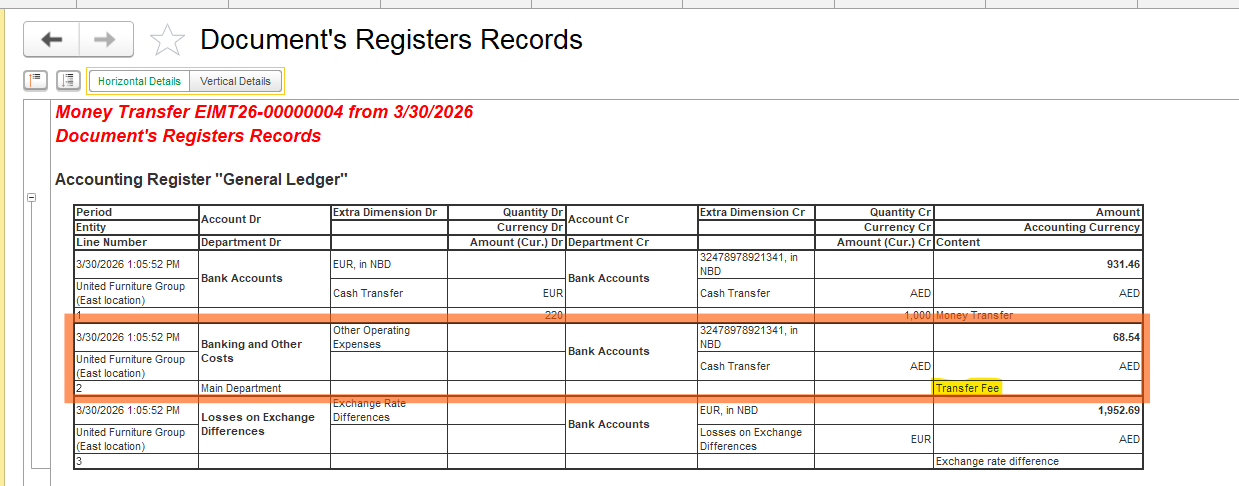
A Foreign exchange difference happens on the Bank account and arises due to changes in the official exchange rate between the date of initial recognition and the date of payment or revaluation. Such differences are automatically recorded in financial result accounts (Exchange Gain/Loss).
Therefore, the system processes money transfers using the exchange rate established in the program as of the document date. Any differences calculated within the transfer document are automatically recognized as income or expense (through the Transfer Fee field), without separately highlighting fluctuations in the bank’s internal commercial rate.
Formula-
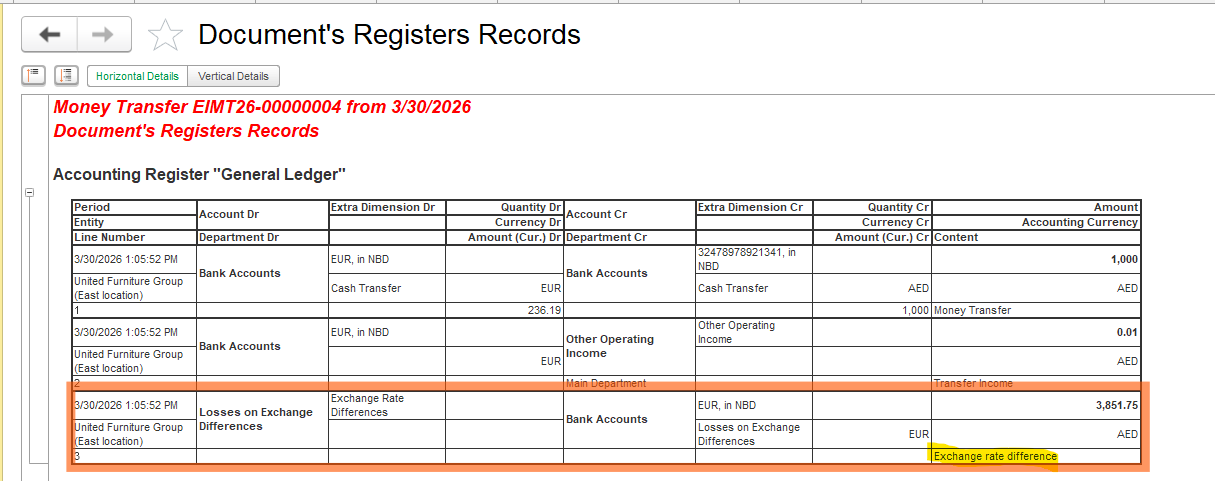
Exchange Difference=Previous Current Balance * Previous Current Rate− Previous Current Balance * Current Rate = 50 000 * 4.310952 (rate for previous transaction) - 50 000 * 4.233917 (rate for current money transaction) = 3851.75
When you make a Money transfer (especially between currencies), there are additional costs:
Bank fees
Losses due to exchange rates (the bank uses its own rate, not the official one)
The system records all of this in the Transfer Fee field. In simple terms - Transfer Fee is everything that gets “lost” or added on top during a transfer.
Types of Transfer Fees:
1.The fee can:
Be added on top
(sent 1000 → 1010 deducted)Be subtracted from the amount
(sent 1000 → 990 received)
2. If It’s a Currency Exchange
Here’s the important part:
The system calculates the amount using the official exchange rate
But the bank actually uses its own (commercial) rate
This creates a difference.
For example - exchange rate difference due to the bank's commercial rate:
You want to transfer 1000 USD
The system calculates at rate 0.236 → one amount
The bank applies rate 0.22 → another amount
The difference = Transfer Fee (hidden bank fee)
Formula (Basically):
Fee = (amount recalculated at new rate) − (amount at old rate)
Another Thing — Exchange Difference
This is a separate issue:
Today’s rate ≠ yesterday’s rate
This changes the value of money in the account
This is called exchange difference, and it can be:
Profit
Or loss
Example of Exchange Difference
Previous Entry
Account Balance: 50,000 USD
Rate at recognition date: 4.310952
In accounting: 50,000 × 4.310952 = 215,547.6
Current Money Transfer
Transfer Amount: 50,000 USD
Rate at document date: 4.233917
In accounting: 50,000 × 4.233917 = 211,695.85
Difference: 215,547.6 − 211,695.85 = 3,851.75 → this is the Exchange Difference
The system automatically compares the current amount with the previous balance, and the resulting difference is recorded as Exchange Difference.
Summary
Transfer Fee = everything you lose during the transfer
Especially important for currency operations
Includes:
Bank commission
Difference due to an “unfavorable” rate
To verify balances in both the foreign currency and the accounting currency, as well as to ensure the correctness of exchange rate difference calculation, please use the Cash Assets Balances report (Money - → Reports of money - → Cash Assets Balances).
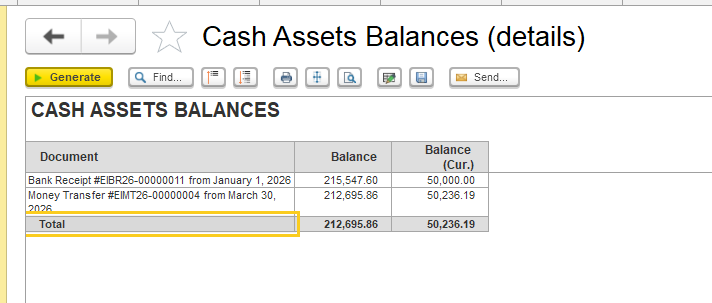
Thus, the exchange rate happens when there is variance on the official rates used in the previous document when compared to current document.
More details about the calculation of exchange rate differences can be found in the manual at the link below.
Overview of Exchange Rate Difference Calculation
Please note that, depending on your accounting policy, you may independently select the expense GL account used to record costs related to transfers. The system does not impose any restrictions on GL account selection — you are free to use the GL account defined in your accounting methodology. From Fr om the program’s side, there are no limitations regarding the choice of account.
...