-
Created by
 Implementation Department, last updated by Daria Tikhova on 24 Apr, 2026
3 minute read
Implementation Department, last updated by Daria Tikhova on 24 Apr, 2026
3 minute read
How to use Transaction Type - Supplier Debt Assignment
Transaction Type 'Supplier Debt Assignment' is useful in cases when:
- It is necessary to change debt from one supplier to another
- Allocate advance payment of one purchase order to another purchase order of the same supplier
- Reallocate deposit amounts between suppliers (e.g. deposit paid via landlord to another supplier)
For example, settle a return of one paid Purchase Order with a new unpaid Purchase Order.
Open Statement of Mutual Settlements - go to Sales / Purchasing / Accounting - Reports - Statement of Mutual Settlements.
As goods in one Purchase Order were returned with Debit Note, then we have it in Advance Paid.
Then Invoice Received is created for a new Purchase Order and appears in Accounts Payable.
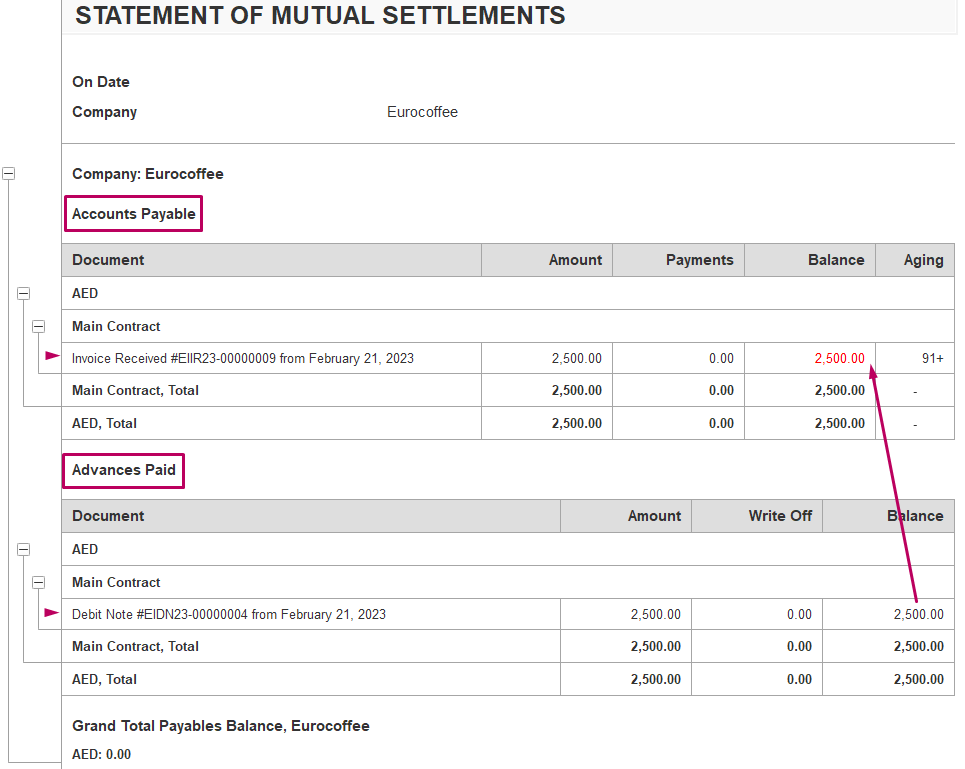
This functionality can also be used when a deposit is paid to one supplier (e.g. landlord) but should be reflected on another supplier.
1. To create Mutual Settlement document
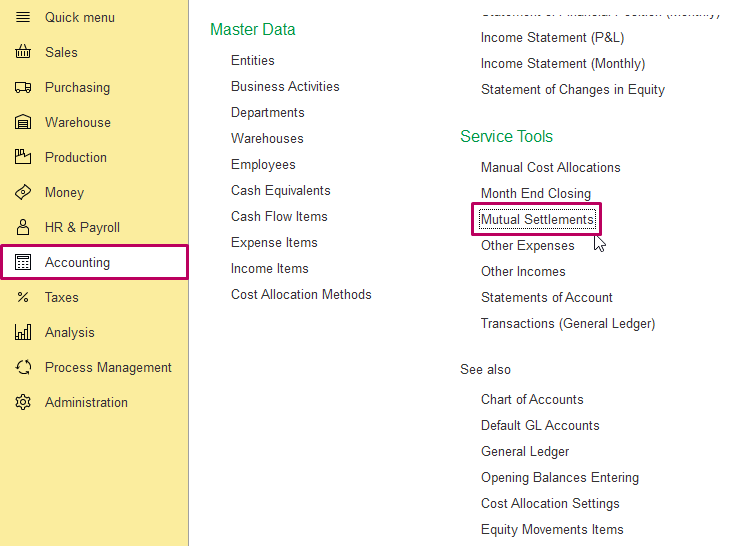
Go to:
Accounting - Service Tools - Mutual Settlements
2. At the Main tab, choose Transaction Type - Supplier Debt Assignment
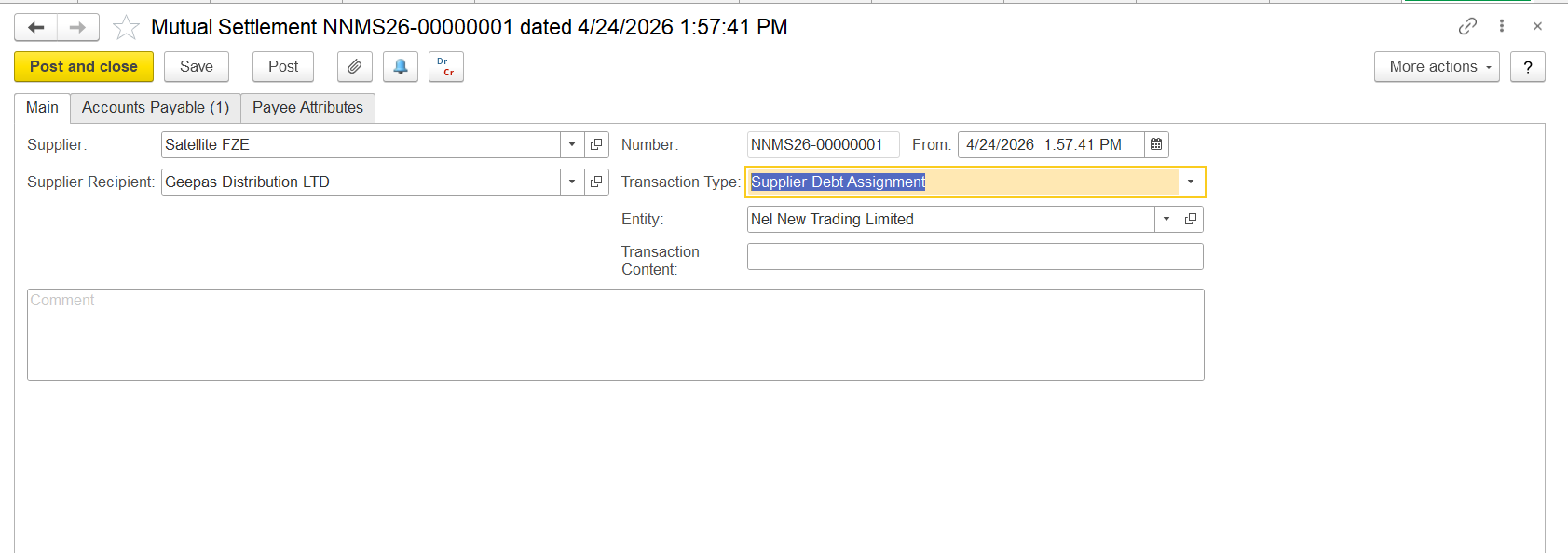
Fill in:
- Supplier (initial counterparty);
- Supplier Recipient (final counterparty)
In case of deposit - Supplier – landlord, Supplier Recipient – service/utility provider for deposit reassignment).
3. At Accounts Payable tab
Use the Pick button to select a document to allocate or amount can be added manually if it is advance (without document)
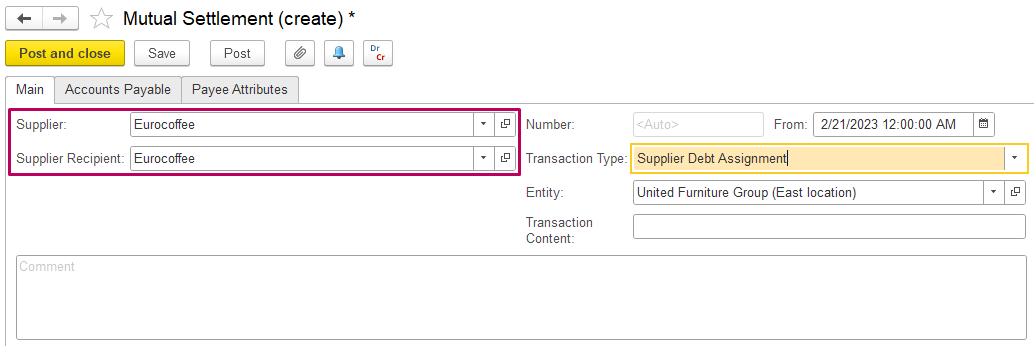
Double-click the document, then press OK.
- Select the payment or liability related to the deposit
- If the payment includes multiple components (e.g. rent + deposit), select only the deposit portion
If the selected document includes a deposit component, choose the relevant deposit amount to be reassigned.
4. At Payee Attributes tab
Specify:
- Contract of the Supplier
- Payment document
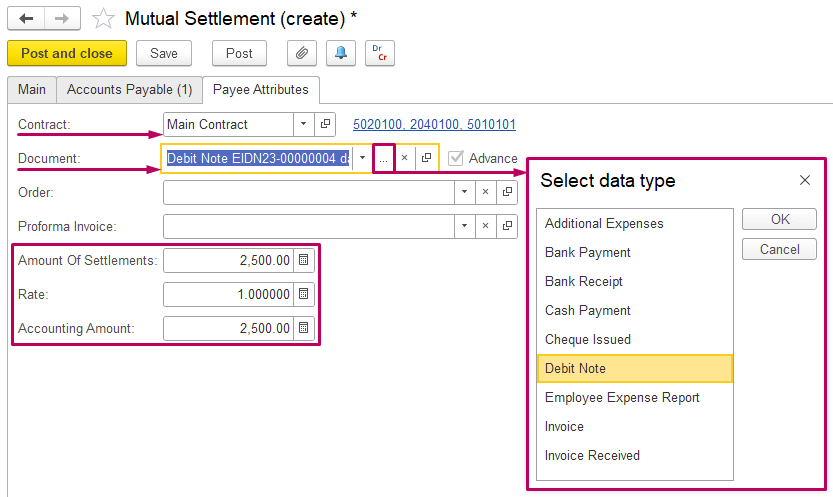
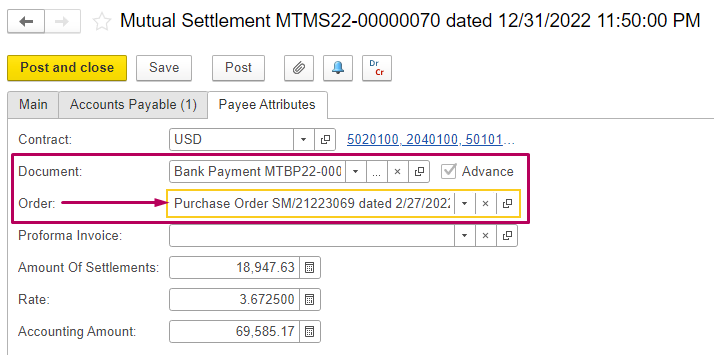
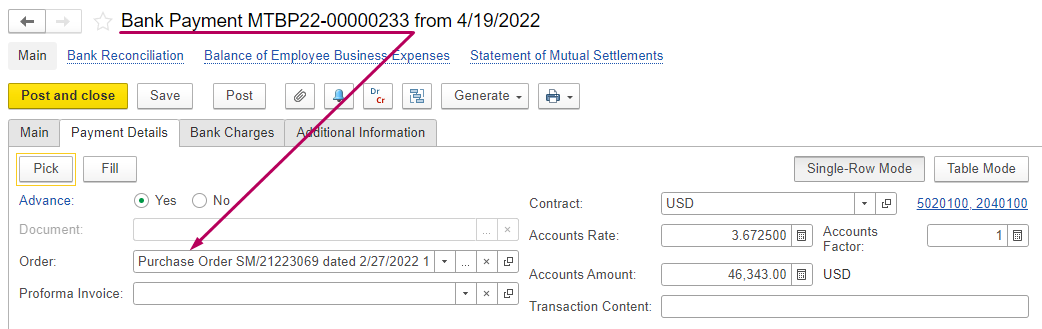
Add an Order if the document is linked to a Purchase Order.
For example, Bank Payment as a payment document relates to some Purchase Order - in this case Order is obligatory to fill.
For deposit reallocation scenarios:
- Choose the payment made to the initial supplier
- Ensure the deposit amount is correctly specified
5. Amount validation
Ensure that:
- Accounts Amount and Accounting Amount (Accounts Payable tab)
- Amount of Settlements and Accounting Amount (Payee Attributes tab)
match exactly
6. Posting the document
Once the Mutual Settlement document is posted:
- The corresponding records are created
- Documents are settled
Result:
- The deposit is no longer assigned to the initial supplier
- The deposit is reassigned to the correct (final) supplier
- Supplier balances are properly adjusted

Important
Do not use Money Transfer or Journal Entry with Transaction (General Ledger) for these scenarios.
These transactions do not correctly reallocate supplier balances and may lead to incorrect mutual settlements.
Thank you for being a FirstBIT customer!