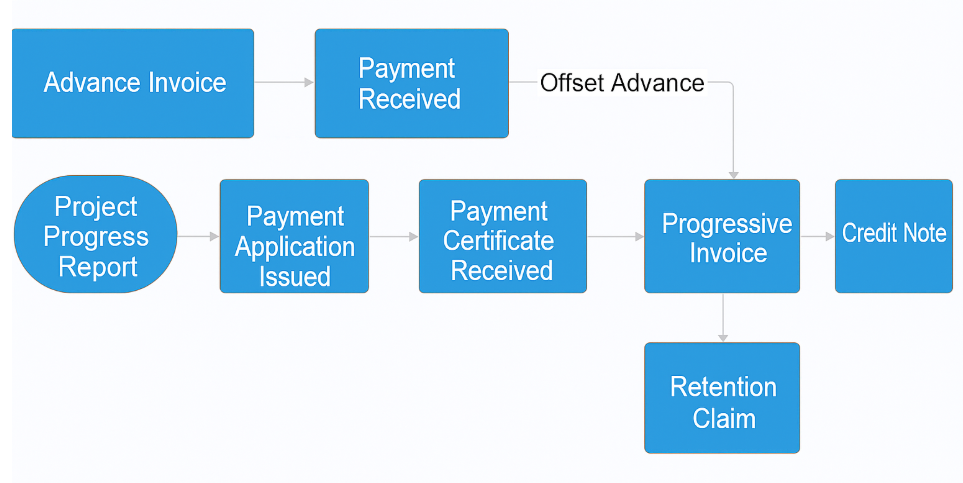
Progress Billing is a payment method in contracting and construction where the client pays the contractor in stages, based on the actual progress of work, rather than making a single final payment.
The process typically includes:
Dividing the project into measurable phases or percentages of completion.
Submit progress Reports at regular intervals (e.g., monthly) to document completed work.
Issuing Payment Applications and Payment Certificates to certify the value of work done.
Generating Progressive Invoices, adjusted for any advances received and retentions withheld.
This approach ensures that payments are directly tied to certified project progress, supporting contractor cash flow while protecting the client’s financial interests.
A progressive invoice is generated through a series of linked documents, reflecting the portion of work completed, after adjusting for advance payments and retention.
It is a percentage (e.g., 10%) of each invoice amount that is temporarily withheld to ensure project completion and defect resolution. In FirstBit, the retention is automatically applied on every invoice linked to a contract with retention enabled. The retained portion is posted separately to Retention Receivables. Once the retention period ends (e.g., after project completion or the defects liability period), the contractor can issue an Invoice (Retention Claim) to release and collect the withheld amount.
Details on how VAT is treated on retention are specified in the contract attributes.
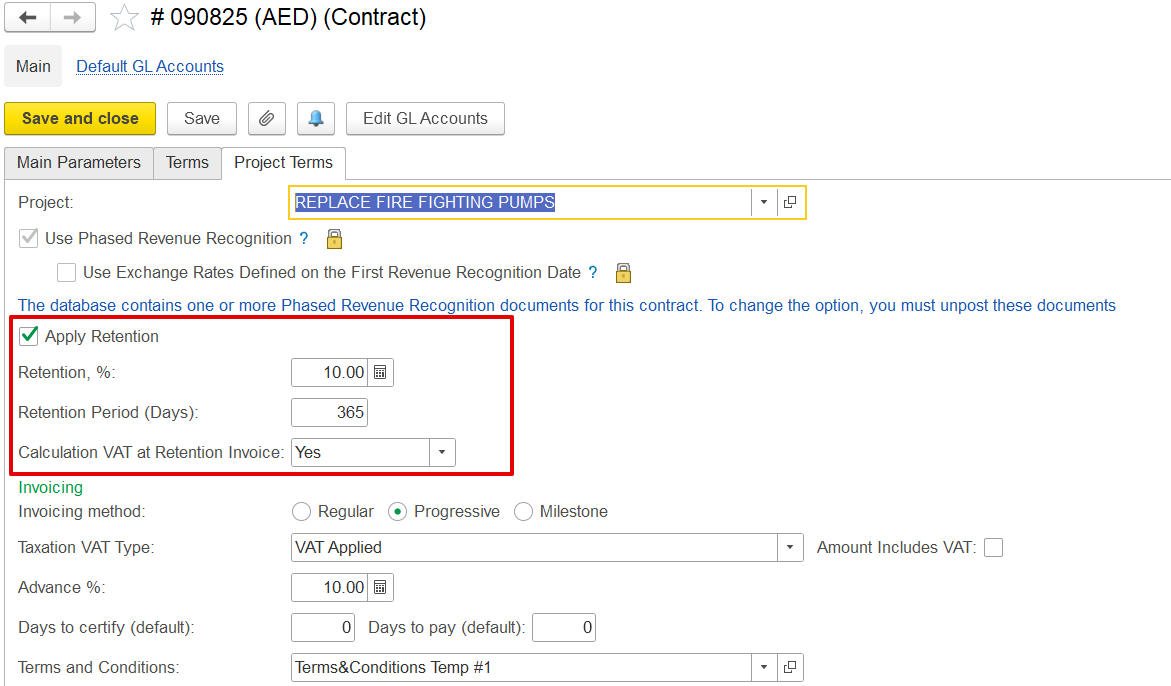
At project completion and after the retention period ends (e.g., 12 months), the system automatically retrieves original retention and VAT details. A Tax Invoice is generated to finalize the retention release and ensure VAT compliance.
The system allows advances paid by the client to be tracked and offset automatically or manually against future progressive invoices. This ensures that only the remaining balance (net payable) is invoiced. The link between the advance invoice and the progressive invoice is maintained, and users can review how much of the advance has been used or is still available.