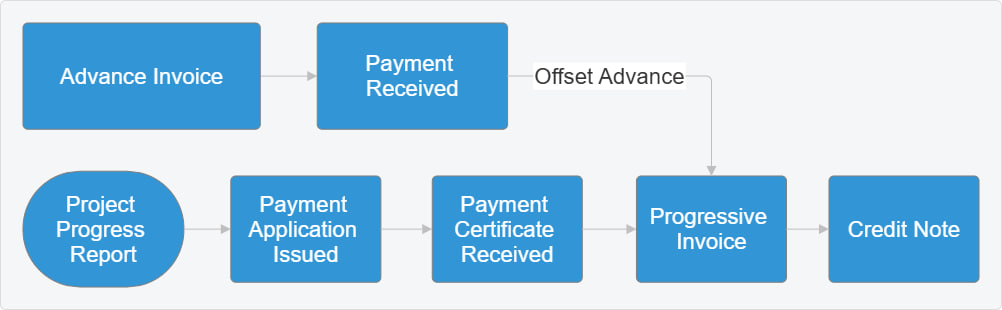
Progress tracking and Billing follow the actual work done at the construction or project site. The system links on-site work updates to financial entries, ensuring that billing accurately reflects the actual progress.
Progress tracking refers to monitoring the actual work completed on-site. This is typically captured in a document called a progress report, which reflects the percentage of completion for different tasks.
Based on this recorded progress, the team generates billing documents such as:
It is a bill for the portion of work completed in a project so far, after adjusting for advance payments and retention.
In FirstBit, a progressive invoice is built through a series of linked documents-
Noted: The system automatically or manually deducts advance payments from progressive invoices to bill only the net payable amount.
It is a percentage (e.g., 10%) of the invoiced amount that is temporarily withheld to ensure the contractor completes the project properly and resolves any defects that may arise. In FirstBit, retention can be applied per invoice or only at the project end, based on contract settings. The retained amount is not lost; it is posted separately to Retention Receivables and can be claimed later.
VAT on Retention can be treated in two ways:
Before Retention – VAT is calculated on the full invoice amount, including the retained portion. This means the client pays VAT upfront, even if part of the payment is held back.
After Retention – VAT is calculated on the net amount (after retention deduction). Later, when the retention is claimed, VAT is again calculated on the retained amount through a separate document. This method aligns VAT with actual payments.
Once the project is complete and the retention period (e.g., 12 months) ends, the retained amount is returned. The system automatically fetches the original retention and VAT details. A Tax Invoice can then be generated to finalize the release and ensure VAT compliance.
The system allows advances paid by the client to be tracked and offset automatically or manually against future progressive invoices. This ensures that only the remaining balance (net payable) is invoiced. The link between the advance invoice and the progressive invoice is maintained, and users can review how much of the advance has been used or is still available.