...
Go to Company Master Data and check the hyperlinks under the company name-Hired Employees and Hired Fixed Assets. Click the appropriate hyperlink.

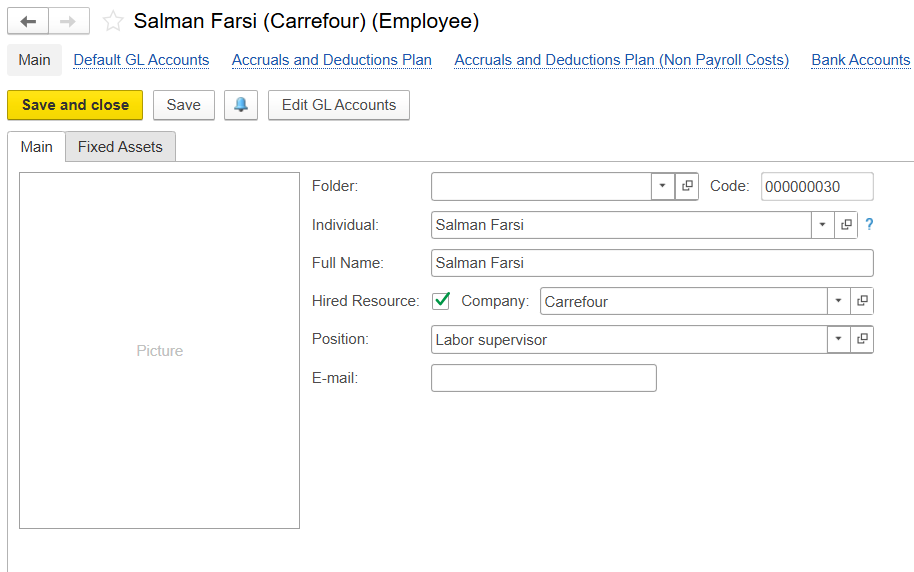
Hired employees
- Folder - Groups employees by department or category
- Code - Unique system-generated ID
- Individual - Short name of the employee.
- Full Name - Legal name used in documents and reports
- Hired Resource - Marks active employees for hiring. If unchecked, it redirects to the company employee creation page
- Company - Legal entity or branch the employee belongs to
- Position - Job title or role
- E-mail - Employee contact detail (email)
2. Hired Fixed asset
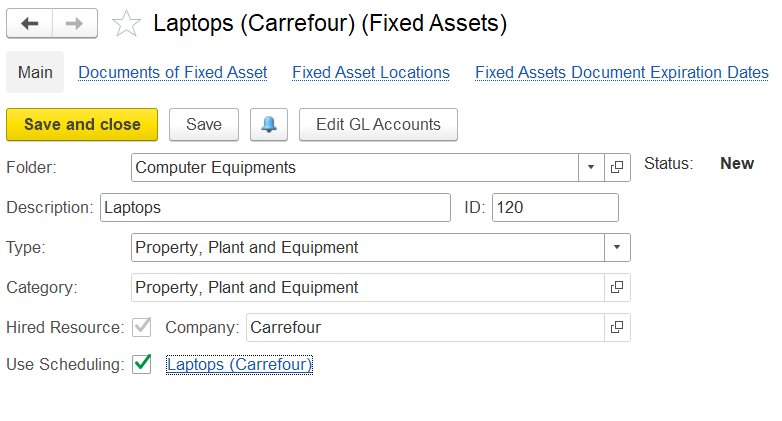
- Folder - Folder to group the asset.
- Status - Indicates the asset’s stage, e.g., New, Construction in Progress, or Construction is complete.
- Description - Short label or name of the asset.
- ID - Unique system-generated identifier.
- Type - Accounting classification.
- Category - Sub-classification under the asset type.
- Hired Resource-Company - Shows which entity owns the asset.
- Use Scheduling - Indicates that a fixed asset is linked to usage planning. When enabled, the asset becomes a schedulable resource with a calendar, allowing users to reserve and manage its availability.
Resource planning document
...
This option is used to allocate specific resources (e.g., labor) to project tasks across defined dates and shifts.
Header section
Entity - The entity managing the resources
Project - The specific project
...
requiring the resources
...
.
Project Task -
...
The particular task within the project.
Position -
...
The role or job title of the scheduled resources
...
.
Shift -
...
Type of working hours or shift pattern.
No. of Resources -
...
Total number of individuals
...
needed.
Shifts Quantity - Total
...
count of shifts planned
...
.
Start/End Dates -
...
The timeframe for which resources are scheduled.

Schedule/Release
- On Date - Assigns the selected employee to a single, specific date, ideal when the employee is needed for only one particular day, avoiding scheduling conflicts.
- For Period - Schedules the employee for the maximum possible days within a given period, covering as many consecutive or available days as possible during the requested timeframe.
- All Available - Automatically selects the first available resources based on the number of resources and days requested, prioritizing resources that can be scheduled continuously for the entire requested period to ensure efficient allocation.
Once a scheduling option is selected, employees are assigned according to that choice. Scheduled shifts are shown in green, and in the next resource scheduling document, they turn red to indicate the employees are already assigned.
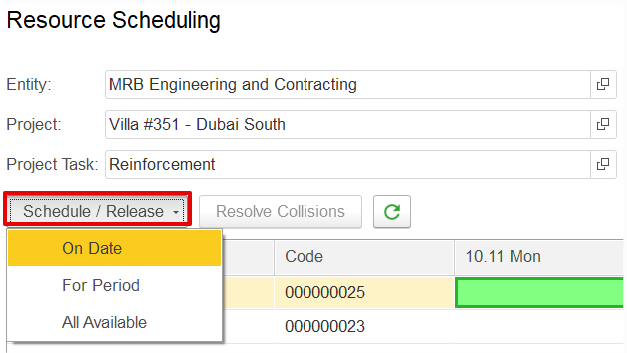
Table field
Employee - Name of the worker assigned to shifts
Code - Unique code of the employee
Date - The specific workday being scheduled
Day - Day of the week corresponding to the date
...
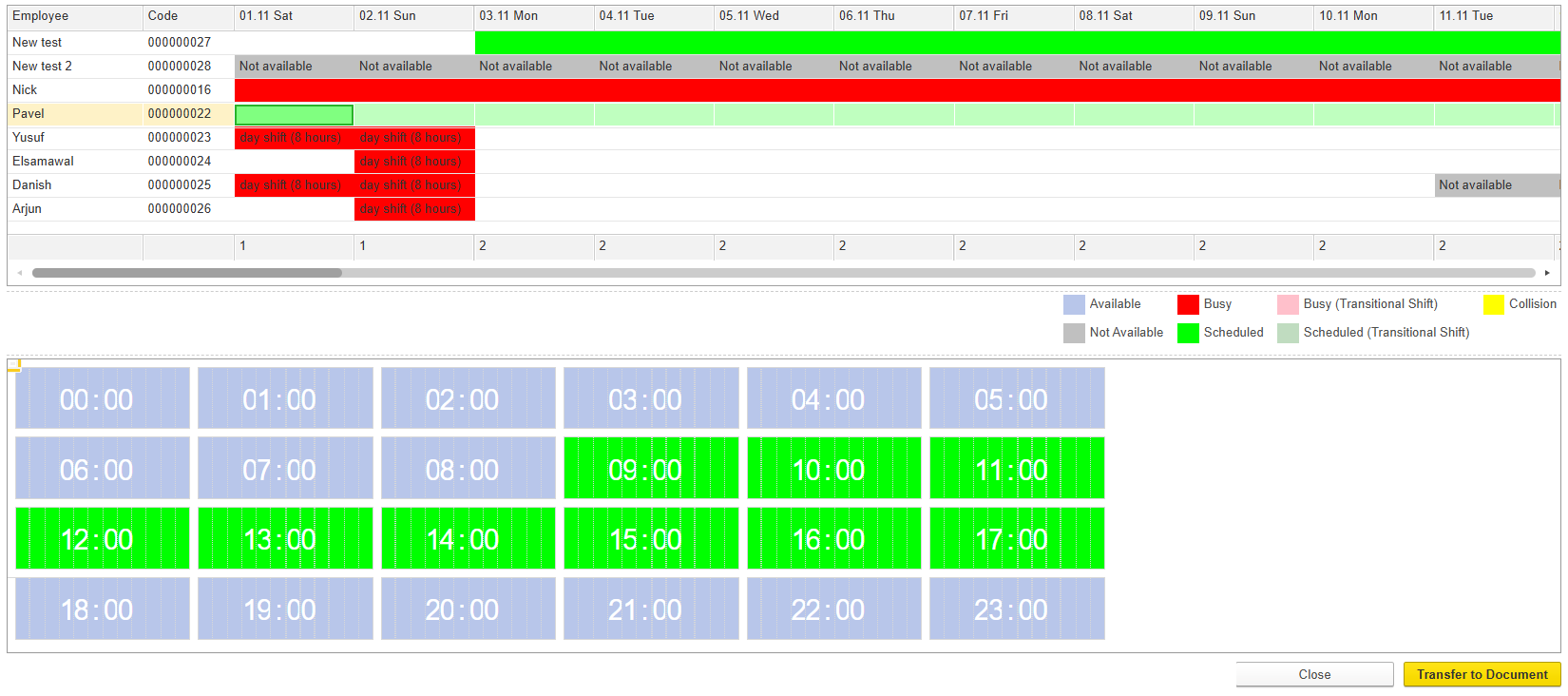
Color | Meaning | Reason / Explanation |
|---|---|---|
| Light Blue | Available | Indicates the resource is free and can be scheduled. |
| Pink | Busy (Transitional Shift) | Indicates a partial or transitional busy shift overlapping with another activity. |
| Yellow | Collision | Indicates a scheduling conflict where overlapping assignments occur. |
| Gray | Not Available | Indicates the resource cannot be scheduled for this day. |
| Red | Busy | Indicates the resource is occupied with a full shift and cannot be assigned. |
| Bright Green | Scheduled | Indicates the resource is fully scheduled for the day. |
| Light Green | Scheduled (Transitional Shift) | Indicates the resource is scheduled for the day with a transitional or partial shift. |
Once scheduled, the data can be sent to the document using the option Transfer to document to finalize the schedule.