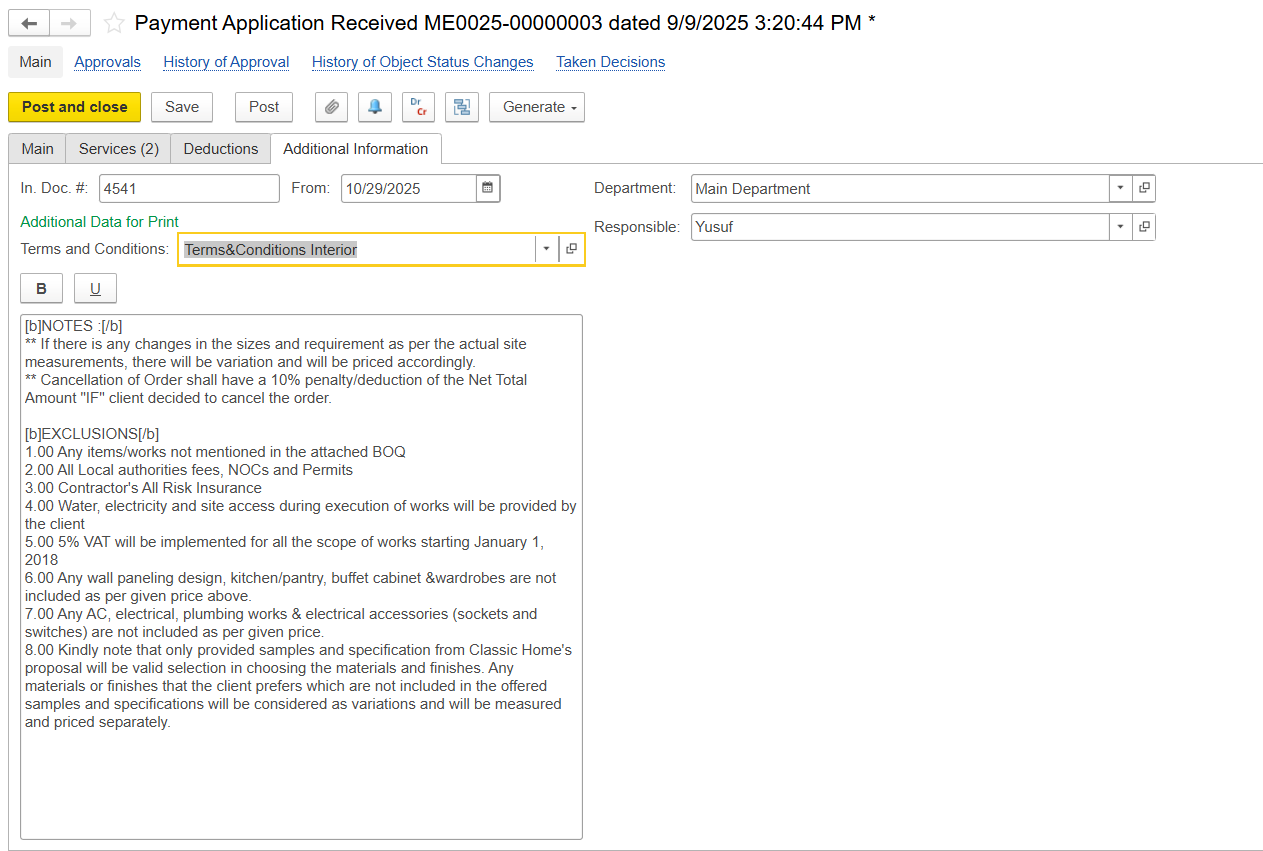
- Deduction
- Advance offset
- Additional information
- keep in mind in this doc we do not use hierarchy of the table it is flat for all subcontractor documents. rest is more or less the same.
- If SA basis marked as recognize Expenses by Payment application, then financial records will be done, based on specified expenses and subcontractor GL accounts and analytics.
The Payment Application Received document is used to record a subcontractor’s claimed amount for work performed under a Subcontractor Agreement (SA). It provides the basis for certifying the value of work completed and, when configured, for recognizing related expenses in the financial accounts.
How to Create
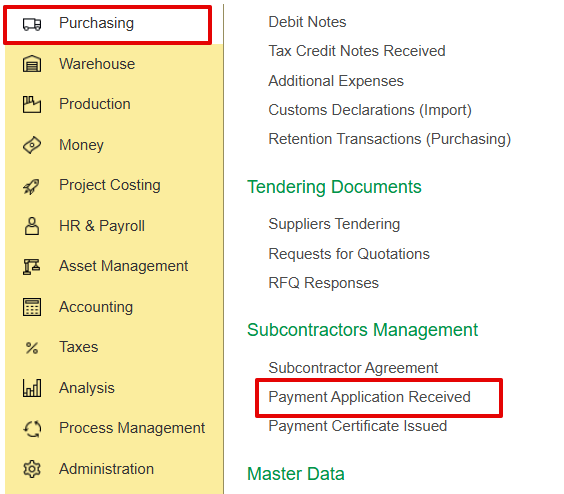
- Project Costing → Subcontractor Management → Payment Application Received.
...
- Purchasing→ Subcontractor Management→ Payment Application Received.
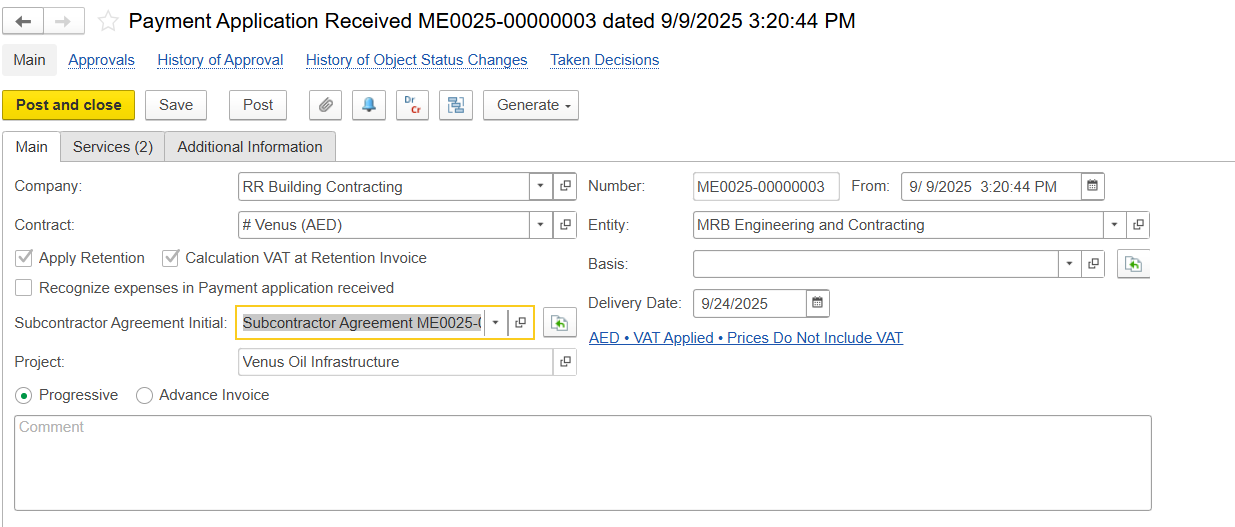
Main Tab
Captures the general details and linkages of the document
Company- Subcontractor submitting the payment request.
Contract- Contract associated with the subcontractor.
Apply Retention / VAT on Retention- Option to hold back a portion of the payment to ensure work quality; VAT is to be calculated on the retained amount.
Recognize Expenses in Payment Application Received -
If the Subcontractor Agreement Basis is set to Recognize Expenses by Payment Application, expense recognition and financial postings occur when the document is approved/posted
GL Transactions:
Dr Expense (based on the linked cost item and analytics)
Cr Unbilled Purchase (liability representing the subcontractor’s claim)
When the subcontractor’s invoice is later received, this liability is cleared to Payables
Subcontract Agreement Initial-Reference to the original subcontract agreement document.
Project- Project linked to the payment claim.
Delivery Date- Indicates the time period or cut-off date for the claimed work.
Type- Indicates the billing method (e.g., progressive billing or advance billing).
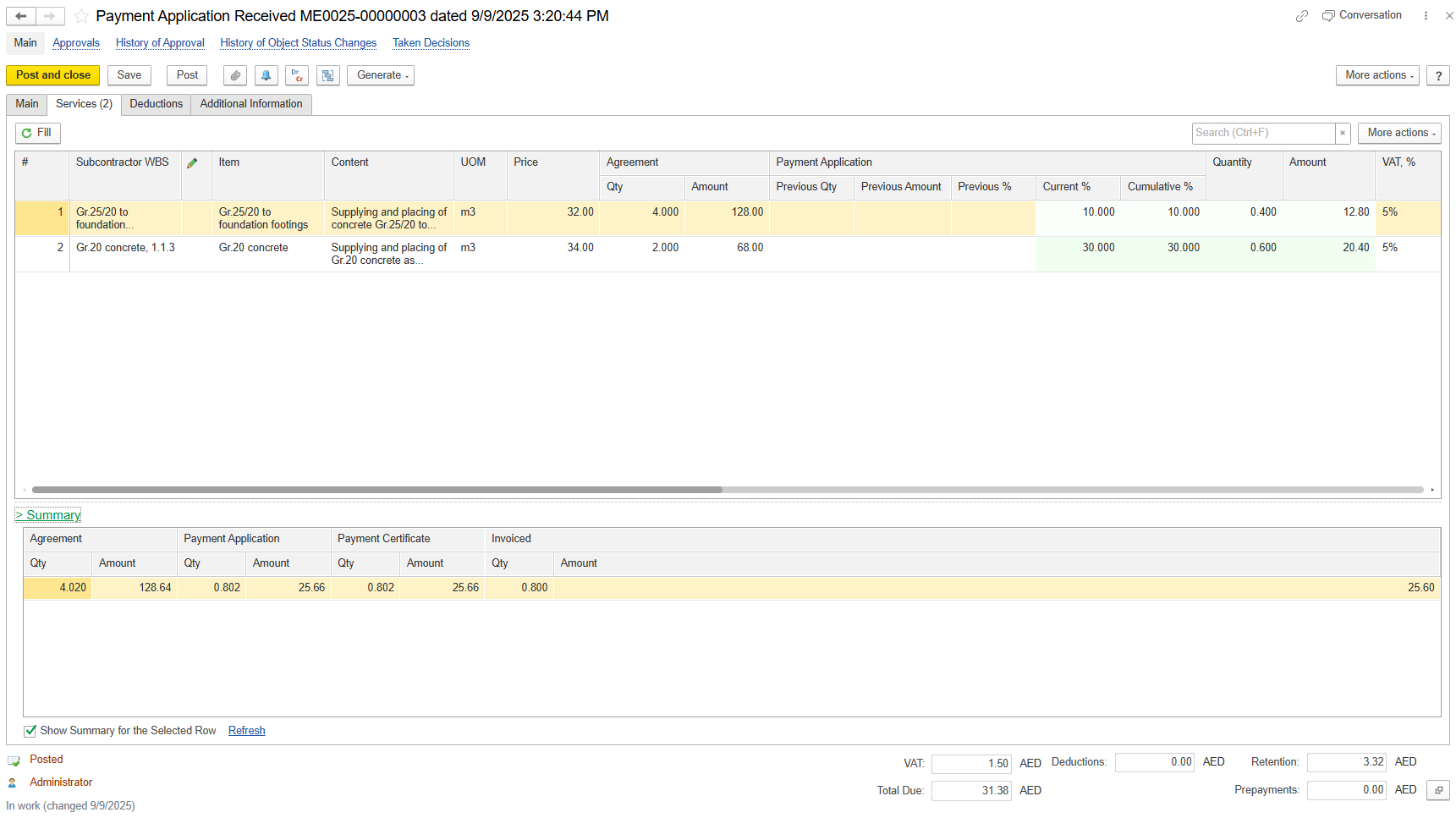
Services Tab
Lists work items or services being claimed. Each line reflects part of the subcontractor’s work scope as defined in the SA.
Subcontractor WBS - Related project WBS code for cost tracking.
Item / Content - Description of work or service performed.
UOM - Unit of measure.
Price - Agreed unit rate from the SA.
Agreement Qty / Amount - Original agreed quantity and value.
Payment Application (Qty / Amount / %) - Quantities or values being claimed in this application.
Payment Application Previous / Cumulative % - Progress history based on earlier applications.
Quantity-Units of work being billed
Amount- Gross value of work before retention and VAT.
VAT %-Percentage Percentage of VAT applied to the billed amount
Retention-Portion Portion of the payment withheld to ensure contractual and quality compliance
Retention %-Rate used to calculate the retained amount
Retention Amount-The The actual monetary value withheld based on the retention percentage
Retention VAT %-VAT VAT percentage applied to the retained amount
VAT Amount-Total VAT calculated (including VAT on retention where applicable)
Total-Net Net payable amount after retention and VAT calculations
Project Task- Specific task the work relates to within the project
Project WBS- Work Breakdown Structure code to classify the tasks within the project hierarchy
Requisition-Original Original request or source of the work order
Department-Department Department responsible for the activity
Business Activity-Work Work category or operational classification
Expense Item-Cost Cost or budget category used for expense tracking
Comment-Additional Additional text or details can be added in the field.
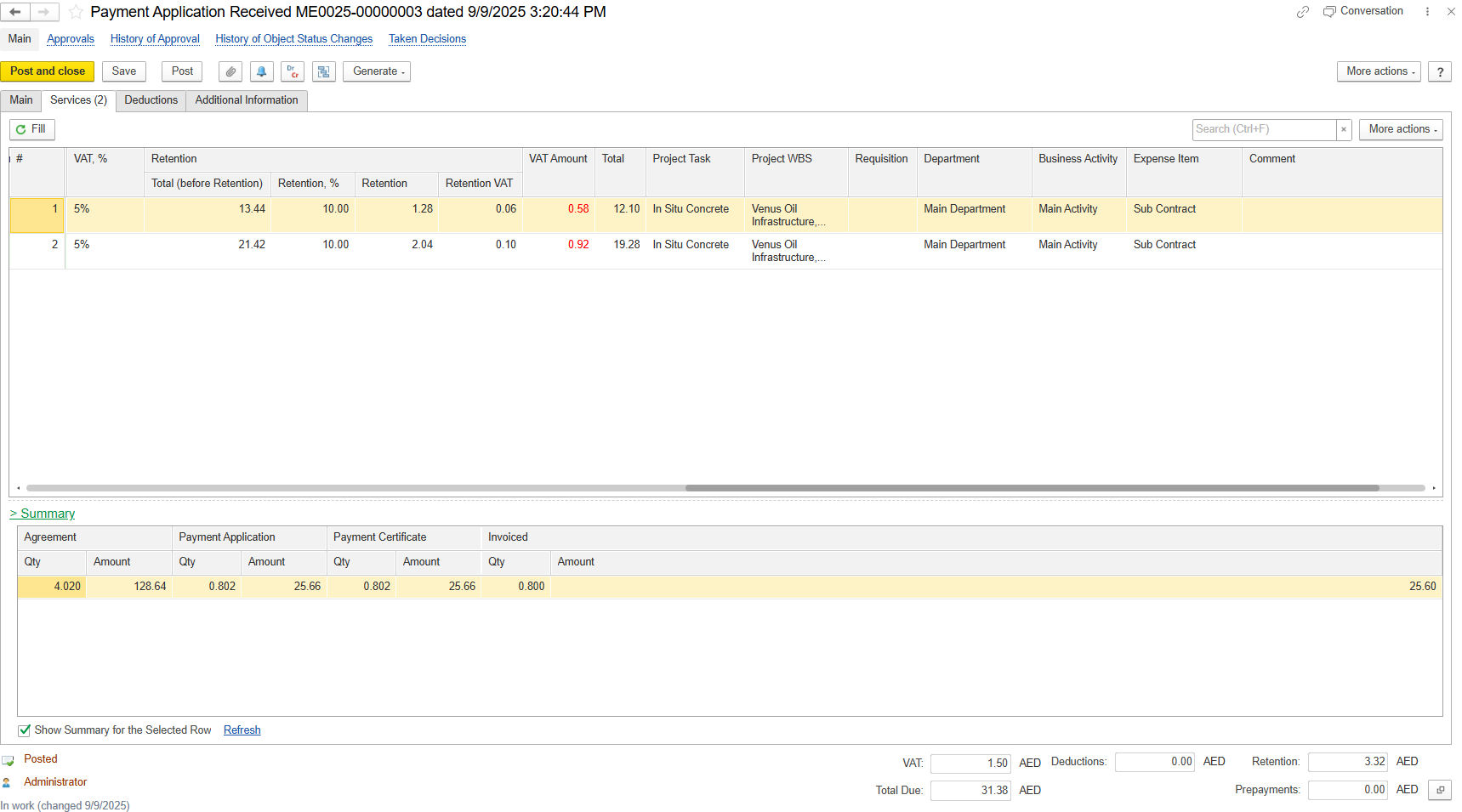
Summary Tab
Shows consolidated totals for the selected service line and the entire document.
...
This tab is used to record deductions applied to the subcontractor’s claim, such as penalties, material supply recoveries, advance recoveries, or other contractual adjustments. Each deduction reduces the total payable amount to the subcontractor.
- Item-Name of the material or service being billed.
- Content / Description-Details or description of the item.
- Quantity-Amount being billed.
- UOM (Unit of Measure)- Measurement unit for the quantity (e.g., Litre, Hour).
- Price (Unit Price)-Cost per unit of the item.
- VAT %-Tax percentage applied to the item.
- VAT Amount-Tax amount calculated from VAT %.
- Amount (Net Value)-Total amount before tax (Quantity × Price).
- Total Amount (Gross Value)-Amount including VAT (Net + VAT).
- Subcontractor WBS-Project Work Breakdown Structure code used to allocate cost to the correct project activity.
- GL Account-Financial account to which the expense or revenue is posted.
- Department-Responsible company department for this cost.
- Business Activity-Internal reporting classification category.
- Income Item / Cost Code-Used for grouping costs or revenue by type.
- Comment-Optional notes or remarks about the line.

Advance Offset
Only the advance payment is recorded as an offset balance and entered into the prepayment field, regardless of the payment method (bank transfer, cheque, etc.). This advance is linked to the current document so that any subsequent linked document automatically carries forward the prepayment. The final accounting offset occurs in the Invoice Received document.
...
Additional Information Tab
This tab is for adding extra details related to the project
In Doc. # and date- Internal or reference document number linked to this payment application.
Department- Department responsible for reviewing and approving the subcontractor’s payment.
Responsible- Person who prepared or approved the payment record.
Terms and Conditions Dropdown- Stores predefined T&C templates for printing.
...
.