used to record adjustments for invoice Received recorded.
for this time skip Inventory tab. only services.
Deduction , retention, settlements
The Debit Note is used to record adjustments to an Invoice Received.
It allows correction of overcharges, service deductions, retention adjustments, or settlement entries related to supplier invoices.
This document ensures that supplier liabilities reflect the correct payable amount after any post-invoice corrections.
A Debit note can be created manually through the
...
purchasing documents screen:
Purchasing → Purchasing Documents → Debit Notes.
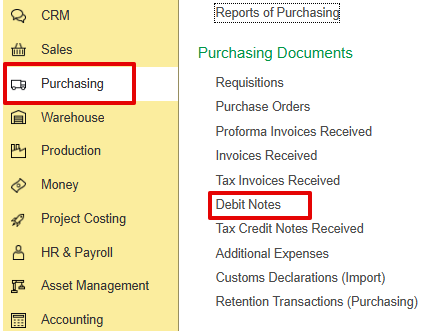
Alternatively, it can be automatically generated from the related invoice received document, which serves as the reference for the debit note. All the details must be automatically filled in.
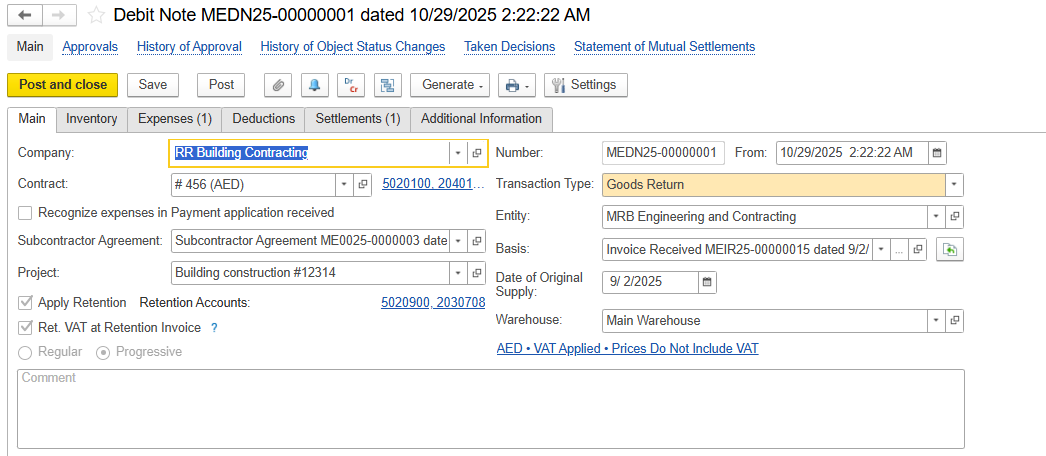
Main Tab
The Main Tab captures the essential details that identify and control how the Debit note is processed.
Company Name-Client Client or company for whom the debit note is created.
Contract-Contract linked to the transaction.
Recognize Expenses in Payment Application Received-When enabled, expenses are recognized automatically.
Subcontractor Agreement-Links Links the debit note to a subcontractor agreement.
Transaction Type-Purpose Purpose of the debit note:
Goods Return-For For returning physical items.
Invoice Correction- To correct amounts/quantities without returning items.
Project-Project associated with the transaction.
Apply Retention / Ret. VAT at Retention Invoice-Apply retention and VAT rules as per contract.
Progressive / Advance Invoice-Indicates if linked to a progressive or advance invoice received.
Basis-Original invoice received is being reversed or adjusted.
Date of Original Supply-Date when the original goods/services were supplied.
Entity Name-Legal entity issuing the debit note.
Warehouse-Inventory location involved (if applicable).
Comment-Internal notes or remarks.
Expense Tab
Item- for each entry in the transaction.
Content-Describes the work or service performed, often linked to WBS.
Quantity (UOM)-Number of units involved, with unit of measure.
Price-Unit price for the item or service.
Discount %-Percentage discount applied to the item, if any.
Discount-Amount of discount applied.
Amount-Total value before VAT and retention; calculated as Quantity × Price minus Discount.
VAT% %-Applicable VAT rate for the item.
Total (before Retention)-Total amount including VAT, before applying retention.
Retention-Percentage of the amount withheld as retention, based on contract terms.
Retention VAT-VAT component of the retention withheld.
- VAT Amount-Monetary value of VAT for the item.
- Total-Net payable amount after applying VAT and retention.
Project Task-Specific task or activity within the project that this item relates to.
Project WBS-Work Breakdown Structure code linking the item to a project task or subtask.
...
Advance-Indicates if the debit note adjusts a previously made advance payment.
Is Deductions- Shows amounts from earlier deductions (like penalties or withholding) included in this debit note.
Document- The original invoice or document linked to this debit note.
Purchase Order-Reference to the purchase order tied to the original invoice or transaction.
Amount-The debited amount related to the original document.
Accounts Payable GL Accounts-General ledger accounts affected by the debited amount.

Additional Information tab
In. Doc#- Unique identifier for the debit note.
From Date- Date when the debit note is issued.
Department- Internal division issuing the debit note.
Responsible- Employee responsible for the transaction.
Reason-Explains the reason or justification for issuing the debit note.
...