...
Project / Project WBS / Expense Item – Identifies the project, its work breakdown structure element, and the corresponding cost category.
Budget Amount – The approved budgeted amount for the specific WBS and expense item.
Orders and Agreements – Total value of commitments, including active and planned agreements.
Current – Value of active contracts or POs already issued and expected to be executed.
Other Remaining – Value of pending or planned commitments not yet finalized, used for forecasting and budget planning.
Materials Delivered – The value of goods received or work completed to date.
Actual Expense – The cost already recognized or posted in the system.
% of Budget – Portion of the budget that has already been utilized.
Remaining Budget Amount – Budget still available after accounting for expenses and commitments.

Revision
Revisions are used to modify the A Subcontractor Revision allows modifying a Subcontractor Agreement before any related documents (e.g., such as Payment Applications) , are processed.
It works similarly to Estimation Revision, allowing updates in At the time of revision, the initial data is copied, and all original parameters are retained.
Revisions enable updates to quantities, rates, or descriptions while maintaining a version history for tracking changes. The system ensures that no request exceeds the limits of the original linked requisition, and multiple versions provide a clear summary of all adjustments, similar to Estimation Revisions.
This can be created using the Generate option; make the necessary changes or amendments in the revision document, and then post.
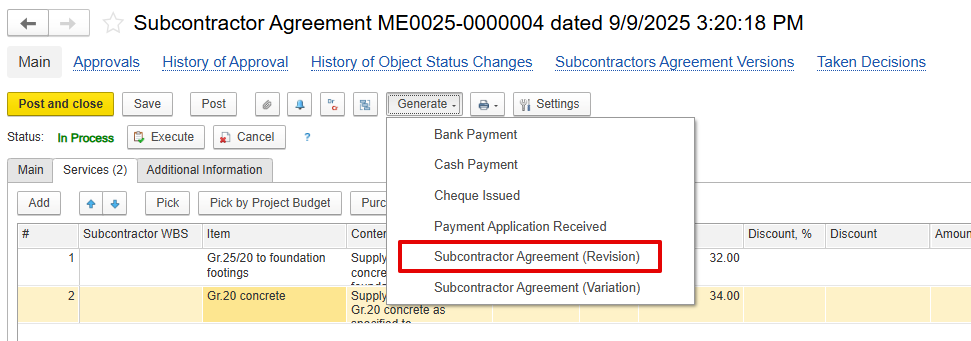
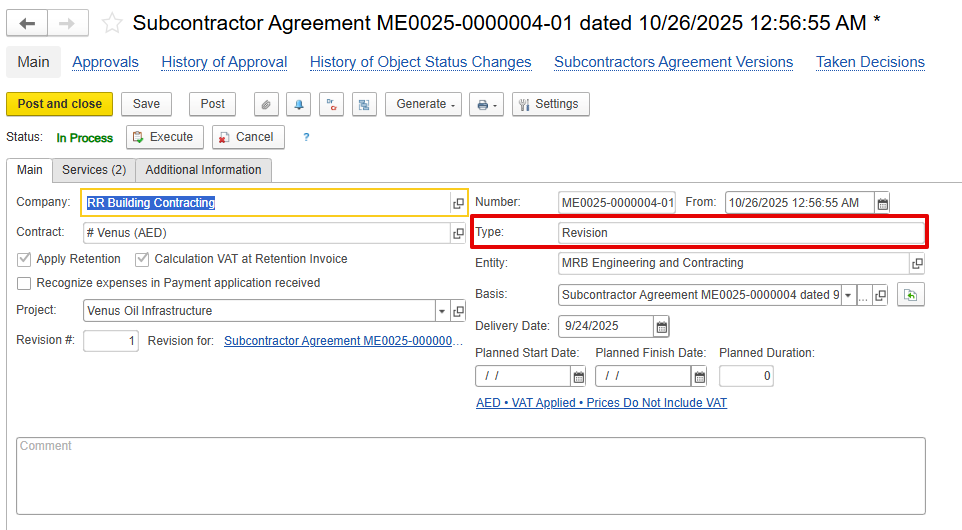
The type will be “Revision,” and the basis will be the initial Subcontractor Agreement.
Variation
Variations are used to record additional or modified work under the subcontract after the initial agreement is in use.
It functions like Variation in Estimation, but is specific to the Subcontractor Agreement.
A variation can be created only based on the latest version of the active agreement.
...