...
Project costing→ Project Progress Reports → Payment Application
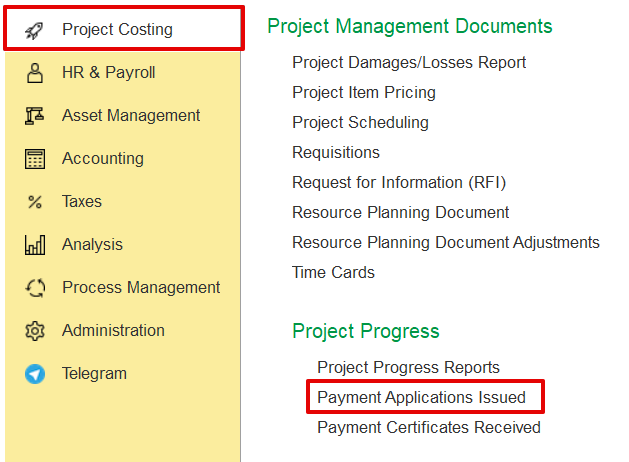
How to Create the Document
Click Create and select the required project from the list.
...
If a project progress report is added as the basis, the system can use it to fill in the document. A confirmation message will appear before replacing any existing data.
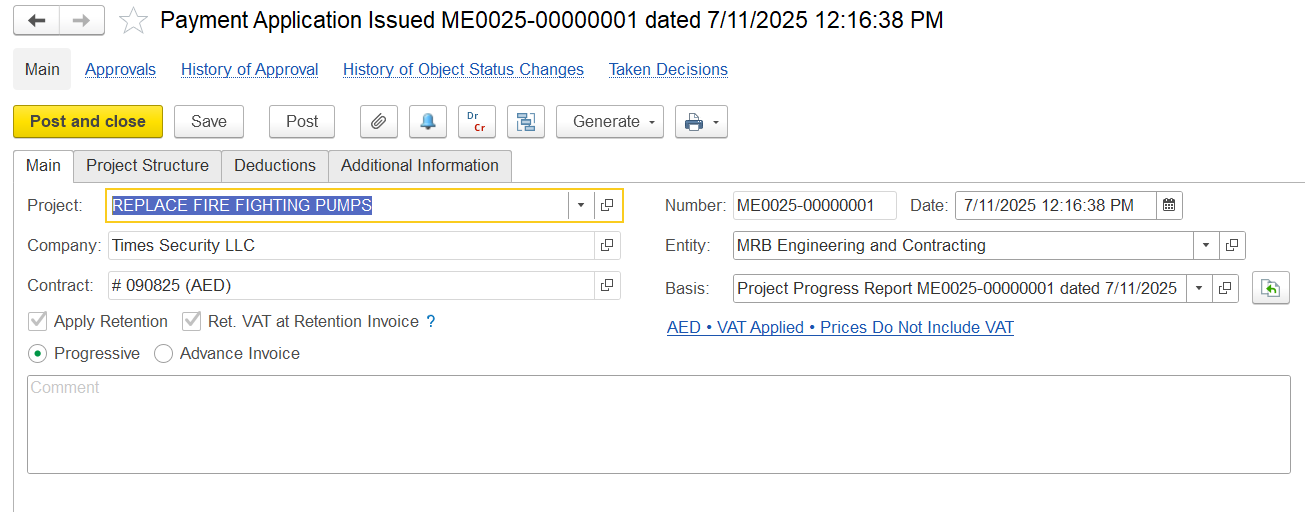
Main Tab
Project - Connects the document to the project and its data.
...
Note: Based on the selected invoice type, the relevant tabs, fields, and calculations will automatically adjust to suit the billing method.
If the Progressive option is enabled, below tabs will be available
Project Structure tab
It displays the list of project tasks with their hierarchy, estimates, progress, and billing details for preparing the payment application.
...
Previous Qty / Amount / % – Work quantities, values, and percentages previously billed.
Current% % – Percentage of work being claimed in this application.
Cumulative% – Total completed percentage including current and previous.
Quantity – Calculated from cumulative % and estimate.
Amount (Excl. VAT) – Net value of current application before VAT.
VAT% – Tax rate applied (e.g., 5%).
Retention Total / % / Retention – Gross amount before retention, retention rate, and retained amount.
Retention VAT – VAT applied on the retained amount.
VAT Amount – VAT on the payable amount after retention.
Total – Final payable amount (amount minus retention plus VAT).
Comment – Any additional remarks, if needed.
Summary linked table
At the bottom of the Project Structure tab, a financial summary section provides a quick view of all key billing values for the current period.
...
Invoiced Qty & Amount – The value already invoiced, typically matching the certified amount unless split or deferred.
Deduction tab
The Deductions tab is used to apply reductions like penalties or back charges before calculating the net payable amount.
...
Total: Represents the complete billing amount, which may include VAT depending on system logic.
Additional Information tab
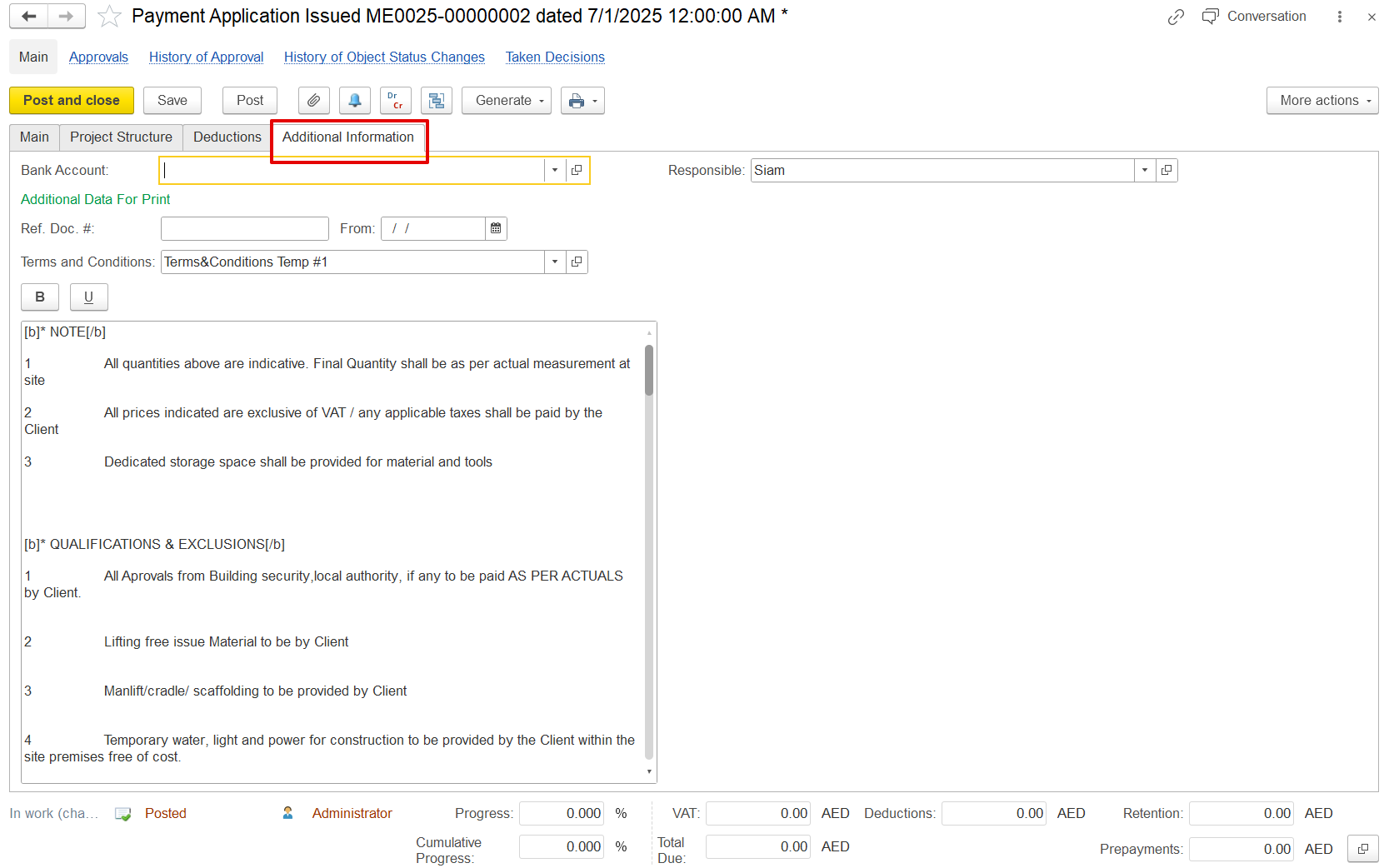
This tab is for adding extra details related to the project
...
These fields do not affect accounting, but they ensure clarity in printed documents like the payment certificate and invoice.
2. If the Advance option is enabled, below tabs will be available
When the Advance Invoice type is selected, the Advance tab becomes available, prompting users to enter the required details. After posting the Payment Application, a Payment Certificate can be generated, which serves as the basis for issuing an Invoice designated as an advance. Once this Invoice is paid, the received amount is recorded as a prepayment and can subsequently be offset against a future Invoice.
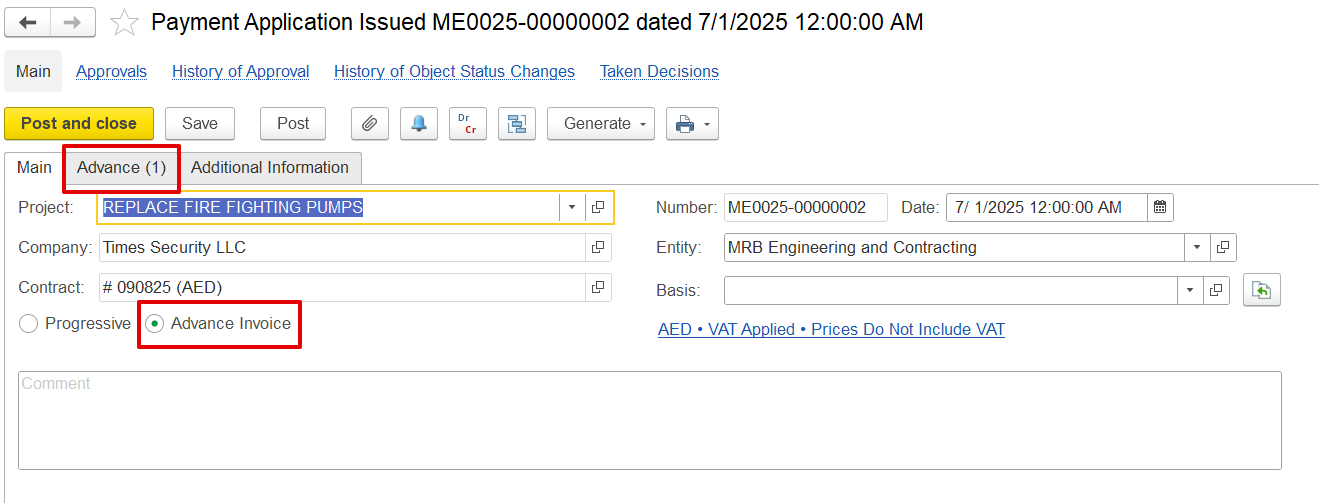
Advance/ Prepayment offset
When an invoice is generated from a Payment Application and Certificate document marked as an advance invoice type, it is recognized as an advance or prepayment. This amount can subsequently be offset within the Payment Application document.
...
While offsetting can occur in the final invoice, including the advance in these documents serves two key purposes:
a) To reflect the advanced impact on the print form
b) To automatically carry forward the advance amount in the prepayment field to subsequent linked documents, such as payment certificates and invoices, thereby eliminating the need for manual selection on each document.
Print form
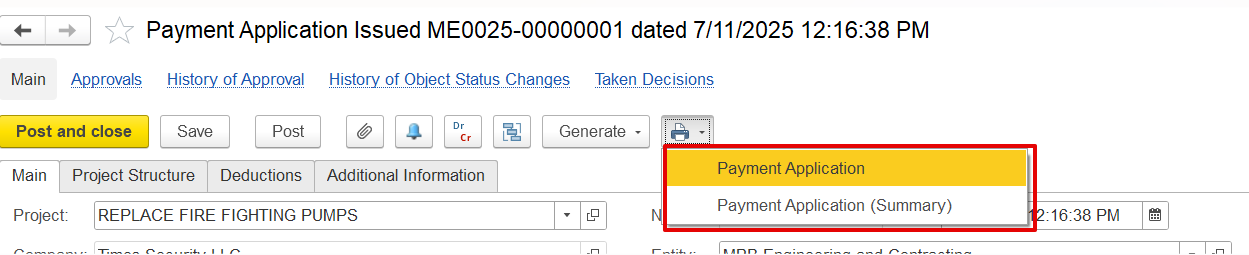
a) Payment Application- It provides a complete breakdown of all items, including VAT, retention amounts, progress details, and any deductions applied.
...