...
The project list displays all projects in the system, organized in this hierarchical structure. If a specific project is not visible, try opening a different folder or using the Search field to locate the project by part of its description or the customer’s name.
The Toolbar Buttons
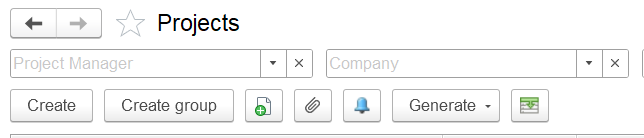
- To add a project, click the Create button on the toolbar. To edit an existing project, double-click the line containing its name. Alternatively, select the line, right-click it, and choose Edit, or use the toolbar option: More actions > Edit.
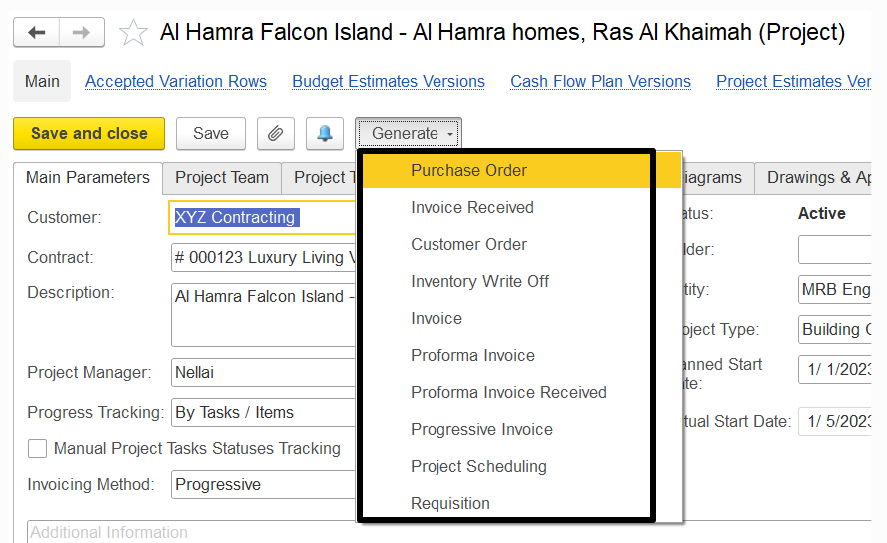
- For a selected project in the list, the Generate button enables the creation of the following document types:
Customer Order – Records the goods and services the customer requests for the project.
Invoice – Bills the customer (client) for goods and services provided within the project.
Purchase Order – Orders goods and services required for the project.
Invoice Received – Registers the purchase of goods and services for the project.
Inventory Write-Off – Records the issue of inventory items from a warehouse for project needs.
Requisition – Requests goods and services required for the project.
Proforma Invoice / Payment Application – Requests payment from the customer (client) for goods and services delivered.
Proforma Invoice Received – Records a supplier’s payment request for goods and services purchased for the project.
Progressive Invoice – Bills the customer (client) based on project progress.
Requisition (for Estimate) – Requests estimated prices of goods and services from the supplier.
3. Creating a folder
To add a group (folder), click the Create Group button on the form toolbar. This opens the Projects (Create folder) dialog box. In the Description field, enter the description of this group (folder).
...
The required fields are: Description, Entity, and Project Warehouse.
 In the Customer field, specify
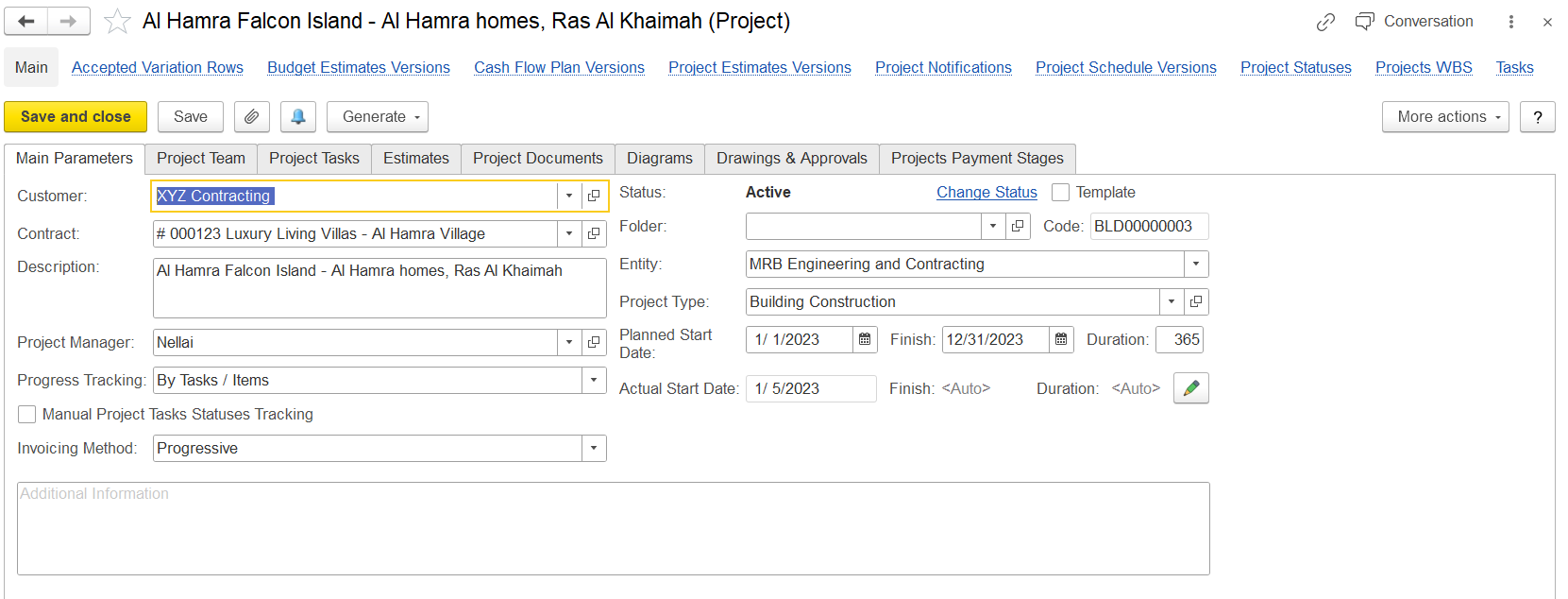
Main Parameters Tab – Field Details
This tab contains key project attributes that define the structure and initial setup of the project.
Customer: Specifies the client for whom the project is intended.
...
Contract: Optionally links a specific contract relevant to the project.
...
Description: A clear and concise description
...
that serves to identify the project in various project lists.
...
Project Manager
...
: Indicates the
...
responsible employee overseeing the project.
...
Progress Tracking
...
: Determines how the project's progress will be monitored. Two tracking types are available:
By Tasks / Items
...
– Progress is measured based on both the
...
completion of project tasks and the consumption of
...
associated items
...
.
By Tasks
...
– Progress is tracked solely based on the
...
status of project tasks.
If you want to track your progress manually by changing the statuses of your tasks then Check the box for the Manual Project Task Statuses Tracking.
In the Project Warehouse field, select the warehouse which will used for consumption of the items in project.
The default status of a new project is Proposed. You can change status as the project moves through different stages in its life cycle. The following statuses are available: Proposed, Active, Completed, and Cancelled. For details, refer to the Project Status Changes subsection below.
If you want to add the project to a specific group of projects, select this group in the Folder field. If the necessary folder has not been added yet, you can create it by clicking to the right in the field and then clicking (Add).
Additionally, by using the Project Type field, you can select the project type among project types defined by using the Project Types form.
In the Entity field, select an entity of your company that is related to this project.
In the Planned Start Date, select the date when it is planned to start the project. In the Finish field, specify the planned finish date of this project. The duration (in days) of the project will be automatically calculated and will appear in the Duration field.
The actual start date can be assigned automatically once you change the project status from Proposed to Active. This option is indicated by <Auto> to the right of the date field. Also, the actual date of the project completion will appear in the Finish field once you change the project's status to Completed, as it is also indicated by <Auto> to the right of the date field.
If you need to specify the start and finish dates manually, click (Edit) to the right. Once you click this button, the Actual Start Date and the appropriate Finish fields become enabled, and you can enter the respective dates.
...
Manual Project Tasks Statuses Tracking: When enabled, allows progress to be manually updated by modifying the status of individual project tasks.
Project Warehouse: Defines the warehouse to be used for issuing materials and items needed for the project.
Status: Represents the current stage of the project. The default is Proposed, and can be changed as the project advances through different life cycle stages. Available statuses: Proposed, Active, Completed, Cancelled.
Folder: Allows grouping the project under a specific folder. New folders can be created directly from the field if required.
Code: A unique identifier automatically assigned to the project.
Entity: Specifies the legal entity of the company managing the project.
Project Type: Indicates the project classification, selected from predefined types in the Project Types form.
Planned Start / Finish Date: Shows the scheduled dates for starting and completing the project. The Duration is automatically calculated in days.
Actual Start / Finish Date: These fields reflect the real dates of commencement and completion. When the project status changes from Proposed to Active, the Actual Start Date is filled in automatically (indicated by
<Auto>). Likewise, the Finish date is updated upon switching to Completed. If needed, the pencil icon (Edit) enables manual input of actual dates.Additional Information: A free-text field for entering any extra details relevant to the project.
The toolbar buttons
After filling out the tab, click the Save button to save the project. Click Save and close to save the project with all the changes and close the form.
...
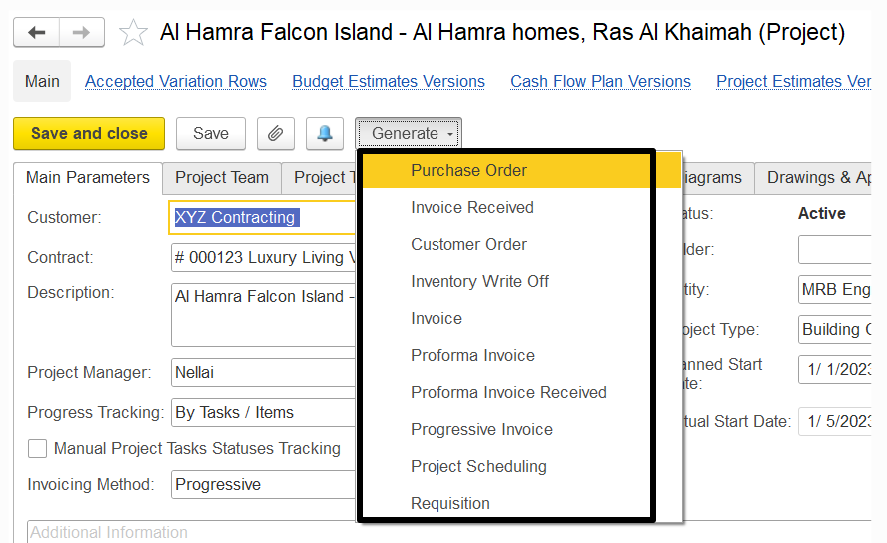
- Quotation: To set the prices to be offered to the customer.
- Customer Order: To record the goods and services requested by the customer in this project.
- Invoice: To bill the customer (client) for the provided goods and rendered services.
- Purchase Order: To order the goods and services required for the project.
- Invoice Received: To register the purchase of goods and services required for the project.
- Inventory Write off: To write off inventory which has been consumed for the project.
- Requisition: To include the items needed for projects in requisition processing.
- Proforma Invoice Received: To record payment request sent by suppliers for the purchase of goods and services required for the project.
- Progressive Invoice: To bill the customer (client) based on the progress of the project.
- Requisition (for Estimate): To request prices of estimated goods and services from the supplier.
Project Status changes
You can change the project status by using the Change status link to the right of the current project status. The link appears once you save the project.
...